Why Study Health Sciences at Westfield State?

The B.S. in Health Sciences at Westfield State University prepares students for careers in healthcare and for advanced study in a wide range of health-related fields. The program combines foundational sciences with patient-centered, interdisciplinary learning so students can build the clinical reasoning, communication, and problem-solving skills needed in today’s healthcare environment.

Program Highlights

  • Coursework focused on job-ready skills
  • Real-world experience through community-based learning
  • Dedicated, highly-qualified professors and experts

Health Sciences Concentrations

Shape the degree around your career  goals through concentrations that gives you a pathway toward direct patient care, community health work, healthcare support roles, or preparation for graduate and professional programs.

  • The Clinical concentration integrates coursework in Health Sciences, Biology, Chemistry, and Psychology to provide a strong academic foundation for students interested in direct patient care and advanced healthcare study. 

  • The Community Health concentration is designed for students who want to improve health outcomes at the population and systems level. This pathway can prepare students for work in community health organizations, medical facilities, long-term care centers, wellness programs, and healthcare administration. This makes it especially relevant for students interested in prevention, health equity, and public health challenges.

  • The Gerontology concentration gives students specialized expertise in the physical, psychological, and social aspects of aging. This concentration prepares students  for roles in long-term care, senior wellness programs, and aging-related healthcare fields, while also providing a strong foundation for graduate study in gerontology or healthcare administration.

  • The Occupational Therapy Assistant concentration is backed by ACOTE Candidacy Status and emphasizes hands-on learning in settings such as hospitals and schools, collaboration with healthcare professionals, and the development of communication and problem-solving skills necessary for individualized patient care.

Program Highlights and Hands-On Learning

The Health Sciences, B.S. program at Westfield State University is built to help students connect academic study with practical healthcare preparation. Rather than approaching healthcare from only one angle, the program encourages students to learn across disciplines and build the type of flexible knowledge base that modern healthcare settings require. This means students not only learn foundational science and healthcare concepts, but also practice teamwork, communication, and problem-solving in contexts that reflect real professional environments.

  • 17:1

    student-faculty ratio

  • 87%

    of students receive financial aid

  • 700+

    Internship Opportunities

Health Sciences Mission, Learning Outcomes, and Curriculum Approach

The curriculum combines foundational sciences with specialized coursework while emphasizing patient-centered care, clinical reasoning, analytical thinking, and interpersonal skill development. Students learn to work across disciplines, respond to public health challenges, and connect clinical care to community-based wellness and prevention. This approach supports graduate-school preparation, faculty-mentored research, and a broader understanding of modern healthcare.

Simulation Labs, Research, and Community-Based Experience

imulation-based instruction, research projects, and collaborative problem-solving help students apply healthcare knowledge in realistic settings and build confidence before entering professional environments. Students gain experience through patient-centered case work, team-based learning, and hands-on practice that supports critical thinking, communication, and clinical decision-making.

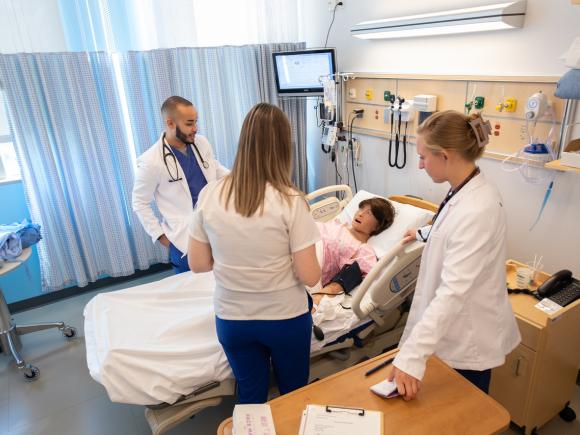
  • Three students engaged in an activity in the Simulation Lab.

    Simulation Labs That Mimic Real Situations

    Westfield State University’s simulation lab uses progressive hands-on teaching methods to replicate patient care situations. You’ll work with high-tech mannequins that simulate symptoms, diseases, and conditions you’ll see in a real patient care setting. 

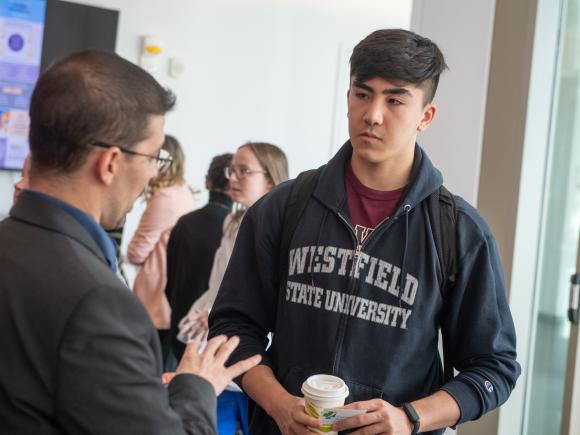
  • Student at Career Fair

    Personalized Plan for Grad School or Career

    With our rigorous core competency courses, including chemistry, anatomy, physiology, medical ethics, research methods, and public health intervention, you’ll develop a solid foundation of knowledge. You can then choose from a variety of targeted elective classes to shape your future—whether it’s entry into the healthcare workforce or graduate school, you’ll be well prepared for what’s ahead.

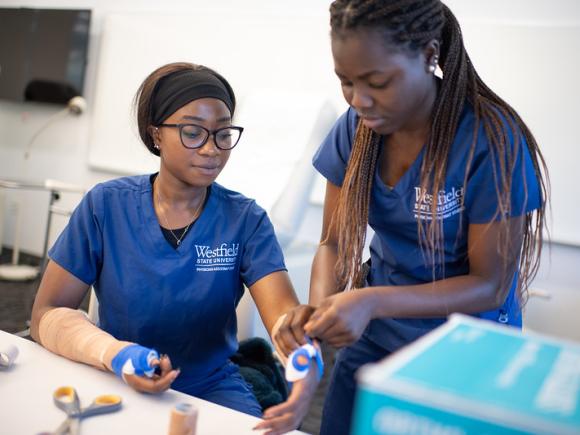
  • Splinting lab featuring two health science students in blue scrubs with WSU logos testing how to splint on eachother.

    Clinical-Focused Research Learning

    As a Health Sciences major, you’ll take courses that emphasize case-based and problem-based instruction, along with simulation. You’ll gain hands-on experience through individual research projects and team-based problem-solving, all grounded in patient-centered care. Collaborate with clinical care centers to prepare for work in a healthcare environment.

Careers and Graduate Pathways in Health Sciences

A B.S. in Health Sciences can support many different next steps in healthcare and related fields. The program prepares students for career paths in healthcare, public health, research, administration, and management, while also building a strong foundation for advanced study.

  • Physical Therapy
  • Occupational Therapy
  • Physician Assistant
  • Nursing
  • Respiratory Therapy
  • Medical Laboratory Science
  • Radiologic Technology
  • Surgical Technology
  • Public Health Education
  • Healthcare Administration and Management
A Physician Assistant student in a cap and gown smiles at commencement.

Faculty Support and Student Success

All our faculty hold graduate degrees in the subjects that they teach. You’ll get personalized attention and experience using a multidisciplinary approach to problem-solving and patient care. Your professors are committed to increasing your knowledge of healthcare through a combination of relevant coursework and individual leadership project opportunities.

Health Sciences Faculty Member Group Photo

Frequently Asked Questions

What concentrations are available in the Health Sciences, B.S. program?

Westfield State University offers four concentrations within the Health Sciences, B.S. program: Clinical, Community Health, Gerontology, and Occupational Therapy Assistant.

Is Health Sciences a good major for graduate healthcare programs?

Yes. The Health Sciences, B.S. program is designed to prepare students for professional healthcare careers and advanced study in health-related fields.

Does the Health Sciences program include hands-on learning?

Yes. Students in the Health Sciences program gain hands-on experience through simulation labs, case-based and problem-based instruction, research projects, team-based problem-solving, and collaboration with clinical care settings.

What kinds of careers can a Health Sciences degree lead to?

A Health Sciences degree can support pathways in areas such as physical therapy, occupational therapy, physician assistant studies, nursing, respiratory therapy, medical laboratory science, radiologic technology, surgical technology, public health education, and healthcare administration or management.

What is unique about the Occupational Therapy Assistant concentration?

The Occupational Therapy Assistant concentration emphasizes hands-on learning in settings such as hospitals and schools, along with individualized treatment planning, care coordination, communication, and problem-solving skills.

Will I get support from faculty in this program?

Yes. Students in the Health Sciences program receive faculty support and personalized attention within a multidisciplinary learning environment.

Do I need SAT or ACT scores or an essay to apply?

 For first-year admission, Westfield State University does not require an application essay, SAT or ACT scores, or letters of recommendation, except in cases where special program admissions requirements apply.

What is the difference between the Health Sciences concentrations?

 Each concentration gives students a different academic focus. Clinical supports students interested in direct patient care or advanced healthcare study, Community Health focuses on population health and wellness, Gerontology centers on aging-related care and services, and Occupational Therapy Assistant provides a more specialized pathway tied to occupational therapy assistant preparation.

Is the Health Sciences major a good fit if I want a flexible healthcare pathway?

Yes. The Health Sciences major is a strong option for students who want a healthcare-focused degree with multiple concentration options and pathways into both careers and graduate or professional study.

Does the Health Sciences program include research opportunities?

Yes. Students can build experience through research projects, case-based learning, and interdisciplinary problem-solving activities tied to healthcare education.

Does the Health Sciences program include simulation labs?

Yes. The program includes simulation-based learning that helps students apply healthcare knowledge in more realistic, hands-on settings.

Can the Health Sciences degree prepare me for public health or community-based work?

Yes. The Community Health concentration is designed for students interested in community wellness, public health, and health-related work beyond traditional clinical settings.

Who is the Health Sciences, B.S. program best suited for?

The program is a strong fit for students who want to build a science-based foundation for healthcare careers, public health work, or graduate and professional programs in health-related fields.

Request Information

We’re here to answer your questions and deliver the support you need along your academic journey. Please provide your contact information and area of interest, and we’ll be in touch shortly.

Name

B.S. in Health Sciences